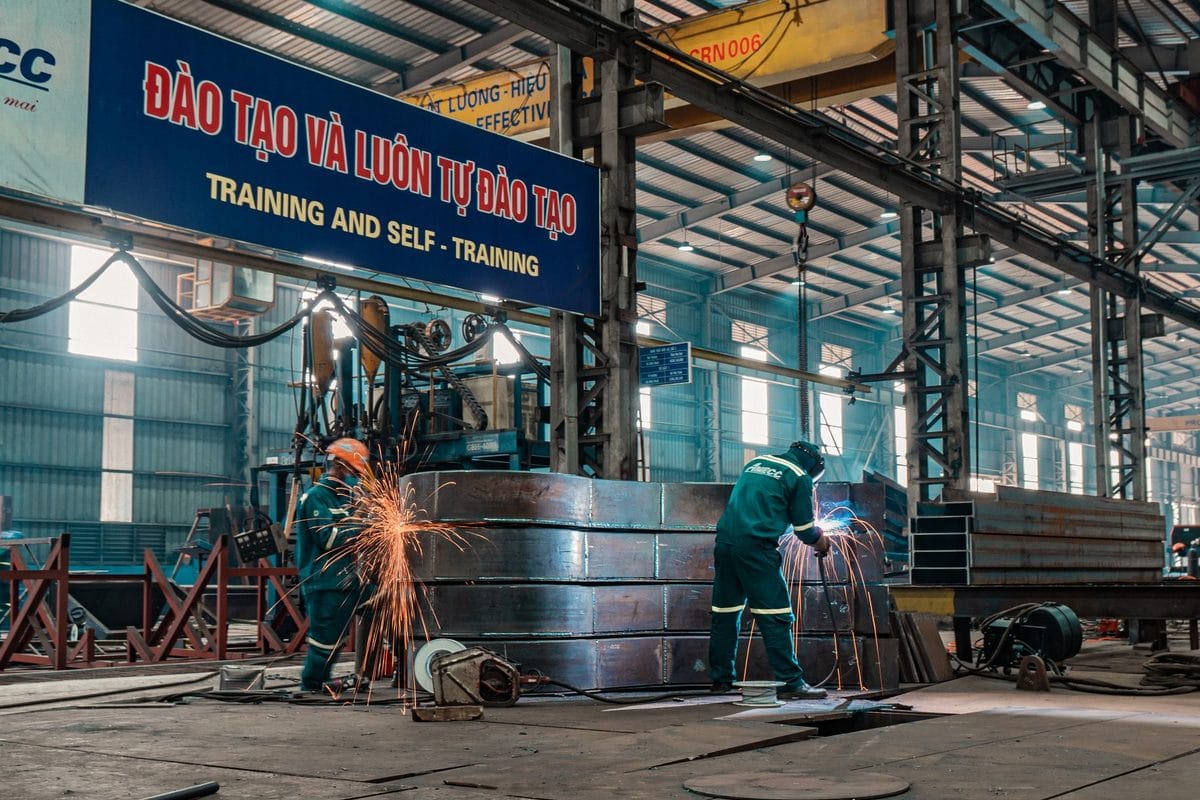
Vietnam has spent the past several years absorbing a growing share of manufacturing investment that companies once concentrated almost exclusively in China, as electronics, apparel and furniture producers pursue what trade analysts commonly call a "China+1" strategy. Industrial parks around Hanoi, Haiphong and Ho Chi Minh City have filled with new assembly lines and component plants, and government figures published by Vietnam's Ministry of Planning and Investment have shown registered manufacturing FDI holding in the tens of billions of dollars annually since 2020, even as overall foreign investment into China has slowed. The shift is not new, but it has broadened in scope, moving beyond low-cost assembly into higher-value component production.
Why Companies Are Moving Now
Three forces are driving the reallocation, and they reinforce each other rather than operating independently. The first is tariff exposure: Section 301 tariffs imposed by the United States on a wide range of Chinese-origin goods, dating back to the 2018 trade dispute, remain in place and continue to shape sourcing decisions for companies selling into the American market. The second is labor cost. Manufacturing wages in China's coastal provinces have risen steadily over the past decade, narrowing the gap that once made Chinese factories the default choice, while wages in northern Vietnam remain considerably lower for comparable assembly work. The third is geopolitical risk exposure — companies with global supply chains have grown wary of concentrating production in a single country subject to export controls, sanctions risk and cross-strait tension, and have told investors as much in earnings calls and supply-chain disclosures over the past several years.
A Trend, Not a Single Decision
None of these drivers acts alone, and none produces an overnight relocation. Shifting a supply chain involves qualifying new suppliers, retraining a workforce and, in many cases, building physical infrastructure from scratch, a process that typically takes several years per product line. What has changed is the direction of the trend: diversification that began as a hedge against tariff risk has become, for many multinationals, a standing feature of long-term sourcing strategy rather than a temporary adjustment.
Which Sectors Are Moving
Electronics has been the most visible beneficiary. Samsung has operated large-scale smartphone and component assembly in Bac Ninh and Thai Nguyen provinces for more than a decade, and its Vietnam operations now account for a significant share of the company's global smartphone output. Contract manufacturers that assemble devices for Apple and other consumer electronics brands have also expanded Vietnamese operations, adding capacity for products that were previously built almost exclusively in China.
- Textiles and footwear — long-established Vietnamese strengths, with major sportswear brands sourcing a substantial share of global footwear production from Vietnamese factories
- Furniture and wood products — driven partly by anti-dumping duties on Chinese wood furniture exported to the United States
- Electronics components and assembly, including printed circuit boards and battery packs
- Solar-panel and battery-related manufacturing, an area that has drawn scrutiny from US trade authorities over Chinese-owned firms relocating production to sidestep tariffs
That last category illustrates a complication in the diversification story: not every factory that opens in Vietnam represents a genuine shift away from Chinese supply chains. US Commerce Department investigations in recent years have targeted solar-cell producers accused of using Vietnam, along with Cambodia, Malaysia and Thailand, primarily to circumvent tariffs on Chinese-made panels rather than to build independent manufacturing capacity.
Infrastructure Under Strain
Absorbing this volume of investment has tested Vietnam's infrastructure in ways that are now well documented by both foreign chambers of commerce operating in the country and domestic industry groups. Electricity supply is the most frequently cited constraint — northern Vietnam experienced rolling industrial power cuts during peak summer demand in 2023, prompting some electronics manufacturers to install backup generation and review expansion timelines. The state utility, Vietnam Electricity, has since accelerated transmission investment and renewable procurement, though grid capacity in the industrial corridors around Hanoi remains tight during hot months.
Port congestion and logistics costs present a second bottleneck. Cat Lai port near Ho Chi Minh City, one of the country's busiest container terminals, has periodically run close to capacity, and inland trucking connections between newer industrial parks and deep-water ports remain less developed than equivalents in southern China's Pearl River Delta. Land clearance and administrative approval for new industrial zones can also take longer than investors initially budget for, particularly in provinces without established track records in large-scale foreign investment. Skilled labor is a further constraint: Vietnam has an ample supply of workers for assembly-line roles, but engineers and technicians for higher-value manufacturing — semiconductor packaging, precision tooling, advanced materials — remain in shorter supply, and many companies still rely on management and technical staff rotated in from other Asian manufacturing hubs.
Competition From Other Destinations
Vietnam is not the only country positioning itself as an alternative to China, and it competes directly with Malaysia, Indonesia, India and, to a lesser extent, Thailand and Bangladesh for the same pool of relocating investment. India has drawn a large share of electronics assembly investment tied to its production-linked incentive programs, while Malaysia has attracted semiconductor back-end manufacturing and testing facilities. Vietnam's advantages relative to these competitors include its extensive network of free-trade agreements — including the Comprehensive and Progressive Agreement for Trans-Pacific Partnership and the EU-Vietnam Free Trade Agreement — its geographic proximity to Chinese component suppliers, and a manufacturing workforce with more than a decade of experience in export-oriented assembly.
That proximity to China cuts both ways. A substantial share of the raw materials and intermediate components used in Vietnamese factories — fabric for garment production, semiconductor components, industrial chemicals — are still imported from China, meaning Vietnam's manufacturing growth has, in part, reorganized rather than eliminated its economic dependence on its northern neighbor. Trade data compiled by Vietnamese customs authorities have shown the country's import bill from China rising in step with its export growth to the United States and the European Union, a pattern that has drawn attention from trade officials assessing rules-of-origin compliance.
What Comes Next
Vietnamese authorities have signaled plans to expand industrial land supply, upgrade transmission infrastructure and streamline investment licensing procedures in provinces beyond the traditional northern and southern industrial hubs. Whether that expansion keeps pace with investor demand will shape how much of the diversification trend Vietnam is able to capture over the coming years, relative to competitors making similar infrastructure and policy commitments across Southeast Asia and South Asia.