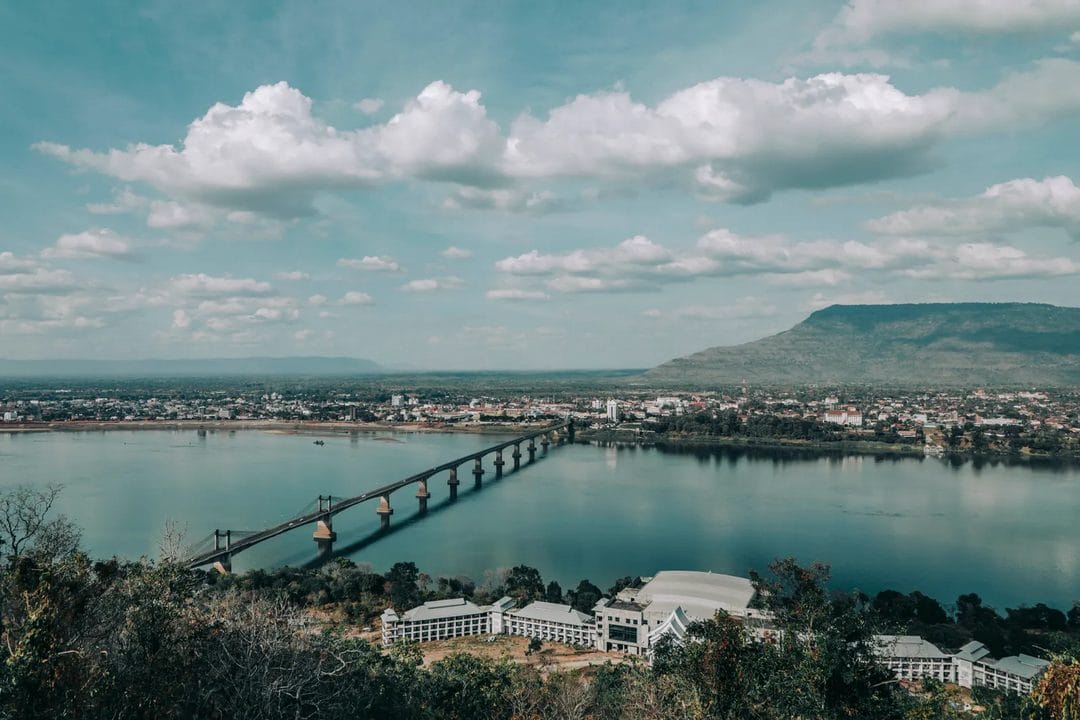
Border trade through Laos's newest Mekong River crossings is running well ahead of government targets in 2026, with two Lao-Thai bridges and a customs checkpoint on the Vietnam border reporting revenue several times higher than planned. The surge is drawing fresh investment into the landlocked country even as its public debt, still equal to well over 100 percent of GDP, keeps Vientiane dependent on debt-service deferrals from Beijing.
The 3rd Lao-Thai Friendship Bridge in Khammouane province collected about $33.2 million in the first half of 2026, an increase of more than 140 percent over the same period last year, according to Lao customs figures. The newer 5th Lao-Thai Friendship Bridge in Bolikhamxay, which only opened recently, had already reached 86 percent of its full-year revenue target within its first six months of operation.
Checkpoint revenue running ten times ahead of plan
The most striking figure comes from the Lalai International Customs Checkpoint in Salavanh province, on the border with Vietnam. Lalai collected roughly $20.7 million in the first half of 2026 — more than ten times its half-year target, according to provincial trade data. Local officials attribute the jump to rerouted freight traffic between Thailand and Vietnam that increasingly bypasses longer coastal routes in favour of the overland Mekong corridor.
Taken together, the three crossings point to a broader pattern. The Lao government approved approximately $8.5 billion worth of new investment projects in the first seven months of 2026, up nearly 70 percent from the same period a year earlier. Much of that capital is tied to logistics, warehousing and processing facilities clustered near the new bridge crossings, rather than the hydropower and mining projects that dominated the previous decade of Chinese-backed investment in Laos.
A debt load that keeps compounding regardless
None of that trade growth has meaningfully eased the pressure on Laos's public finances. The International Monetary Fund's most recent Article IV assessment put Laos's public and publicly guaranteed debt at close to 118 percent of GDP for 2025, among the highest ratios in Southeast Asia. Roughly half of that external debt is owed to China, largely tied to the $6 billion Lao-China high-speed railway completed in 2021 and a string of hydropower projects financed under Belt and Road terms.
The Lao kip has lost about 60 percent of its value against the US dollar since 2022, driving up the local cost of imported fuel and food even as trade volumes rise. Vientiane has avoided a formal default largely through repeated debt-service deferrals from Beijing and an $800 million currency swap line extended by the People's Bank of China in 2024. Separately, the state utility Électricité du Laos sold a 90 percent stake in the country's domestic power transmission grid to China Southern Power Grid's Yunnan unit for $625 million, a transaction Lao officials described as a capital injection rather than a debt restructuring.
Growth without much room to absorb a shock
Nominal GDP growth has slowed as the debt burden has widened, from 4.5 percent in 2024 to an estimated 2.5 percent for 2026, according to IMF projections, even as border trade volumes climb. That divergence — rising transit revenue alongside slowing broader growth — is central to how economists assess Laos's position within the Mekong subregion. The Lowy Institute has argued that Laos cannot grow its way out of the debt crisis through infrastructure-driven trade alone, since debt-service costs have already risen roughly fourfold since 2016 and now consume a growing share of state revenue regardless of how much freight crosses the new bridges.
For Thailand and Vietnam, the calculus looks different. Both countries have leaned on the upgraded Lao crossings to diversify freight routes away from congested seaports, and Vietnamese exporters in particular have used the Lalai checkpoint to move goods toward Thai markets without the delays associated with maritime shipping. Vietnam is also positioning itself as the connective hub for the wider corridor: Ho Chi Minh City is hosting a regional tourism and trade expo from August 27 to 29, where Vietnamese officials plan to promote a joint travel and logistics corridor spanning Laos, Cambodia, Myanmar and Thailand.
Where the new investment is actually landing
Provincial officials in Khammouane and Bolikhamxay say the bulk of the newly approved projects near the bridge crossings are dry ports, cold-storage warehouses and light-assembly facilities aimed at goods in transit rather than manufacturing for the domestic Lao market. That distinction matters for how much of the trade boom actually benefits the Lao economy directly, since transit and logistics fees generate government revenue but create comparatively few permanent jobs next to the kind of factory investment Vietnam has attracted from firms relocating out of China.
Thai and Vietnamese logistics operators have also adjusted on their side of the border, rerouting freight that previously moved through longer coastal shipping lanes onto the overland corridor instead. That shift in routing decisions, made independently by private freight forwarders rather than mandated by any government, is what has allowed volumes at Lalai and the newer bridge crossings to run so far ahead of the multi-year projections built into the original financing plans.
What the Mekong River Commission is tracking next
The Mekong River Commission Secretariat has also stepped up engagement with Lao officials this year, with its chief executive meeting Lao industry and commerce officials in early August to discuss the commission's 2026–2030 strategic plan for basin-wide water management. That agenda sits alongside, rather than inside, the trade and debt questions — but it underscores how many separate institutional tracks are now converging on the same stretch of river.
Whether the current trade momentum can be sustained past 2026 depends heavily on whether Thai and Vietnamese logistics firms continue rerouting freight through Laos rather than treating the current volumes as a temporary detour around coastal bottlenecks. Lao officials have not indicated any plan to renegotiate the terms of existing debt agreements with Beijing in the near term.