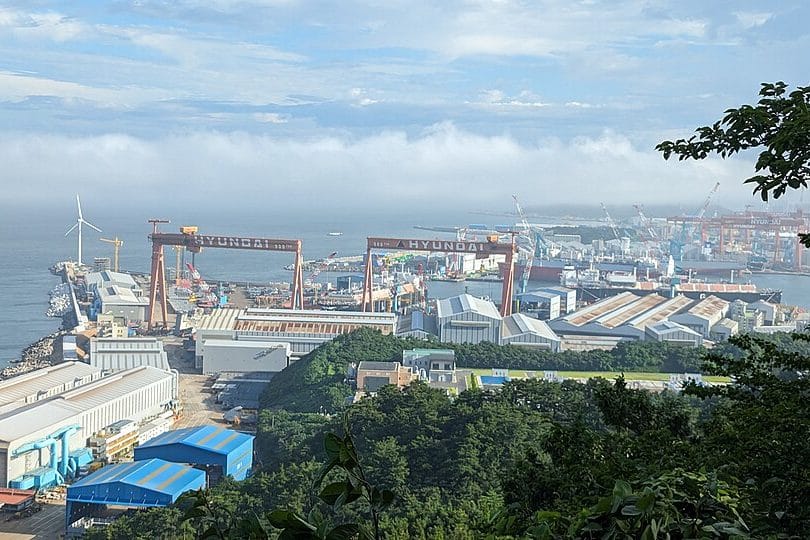
South Korea's two largest shipbuilders, HD Hyundai and Hanwha Ocean, are moving from paper commitments to steel-cutting on a pledge to invest up to $150 billion in the US shipbuilding sector, the centerpiece of the trade agreement Seoul and Washington struck in 2025. The program, known informally in Korean industry circles as MASGA — "Make American Shipbuilding Great Again" — was the price South Korea paid to bring its reciprocal tariff rate down from a threatened 25 percent to 15 percent. A year on, the gap between the pledge and a working shipyard is where the deal is now being tested.
Philly Shipyard is the first real proof point
Hanwha Ocean bought Philly Shipyard for roughly $100 million in late 2024, becoming the first Korean shipbuilder to own a yard on US soil. Since then, the Philadelphia facility has been the clearest evidence that Korean capital is actually landing in American shipbuilding rather than sitting in a fund. Hanwha has used the yard to build commercial tankers and has positioned it as a base for both Jones Act-compliant vessels and, eventually, support work tied to the US Navy.
HD Hyundai, the parent of Hyundai Heavy Industries, has taken a different path, leaning on maintenance, repair and overhaul work rather than a single flagship acquisition. Both companies won contracts under the US Navy's 2024 pilot program that allowed foreign yards to service non-combatant vessels — a narrow opening in a US shipbuilding market still bound by the Jones Act, which requires ships moving cargo between American ports to be US-built, US-flagged and largely US-crewed.
The MRO opening is narrower than it sounds but symbolically larger than its dollar value. In 2024, Hanwha Ocean's Geoje shipyard carried out the overhaul of the USNS Wally Schirra, the first time a Korean yard had serviced a US Navy vessel — a contract worth a few million dollars against a shipbuilding pledge measured in the hundreds of billions, but treated in Seoul as proof the relationship could extend past commercial cargo ships. HD Hyundai signed its own Master Ship Repair Agreement with the US Navy that December, giving it the paperwork to bid on similar work without a fresh approval each time.
The $150 billion figure covers more than new hulls
Korean officials have been careful to note that the headline number is not a check written for warships. It spans commercial shipbuilding capacity, port and drydock modernization, workforce training pipelines, and equity stakes and loan guarantees channeled through a joint investment vehicle rather than direct grants. That structure has itself become a point of friction. Seoul had pushed for a currency swap arrangement to cushion the won against the scale of outbound capital, a request Washington did not grant, and negotiators on both sides have spent months since the initial announcement working out how profits, losses and decision-making authority inside the fund are actually split.
- The Jones Act remains the single largest structural constraint on how fast Korean capital can convert into finished ships for the US domestic fleet.
- Workforce shortages at aging American yards — welders, pipefitters, marine engineers — are a bottleneck Korean firms cannot simply fund their way around; training new crews takes years, not quarters.
- Currency and profit-sharing terms inside the investment vehicle are still being negotiated line by line, according to Korean trade officials, even as individual shipyard deals move forward.
Washington's shipbuilding gap is decades in the making
The US share of global commercial shipbuilding output has fallen to a fraction of a percent, dwarfed by China, South Korea and Japan, which together account for the overwhelming majority of the world's new vessel tonnage. That imbalance is precisely why the Trump administration made shipbuilding capacity a named condition of the tariff settlement rather than leaving it to a general investment pledge. For Seoul, the arrangement offers a foothold in the US Navy's long-term fleet plans and a hedge against oversupply in Korea's own yards, which have cycled through boom-and-bust demand for LNG carriers and container ships over the past decade.
South Korean shipbuilders are not new to the US market in the way the headlines suggest. HD Hyundai and Hanwha Ocean have supplied components, engines and technical licensing to American shipbuilding for years; what changed in 2025 is the scale and the explicit linkage to tariff relief. That linkage is also why delays carry political weight on both sides — a stalled fund disbursement or a missed hull delivery reads in Seoul as a broken trade commitment, not just a commercial hiccup.
What comes next
Both companies have signaled further US capacity announcements are likely before the end of the year, though neither has confirmed a specific site beyond the existing Philly Shipyard footprint. The US Navy, meanwhile, is expected to expand the pool of MRO contracts open to foreign-owned yards, a step that would give HD Hyundai and Hanwha Ocean a larger foothold without requiring new Jones Act carve-outs. Trade officials in Seoul have said the joint investment fund's governance terms are close to being finalized, though they have repeatedly said the same over the past several months.
The test for MASGA was never going to be the announcement — it was always going to be whether hulls actually leave a US drydock on schedule. Philly Shipyard's order book over the coming quarters will be the first hard data point on that question.