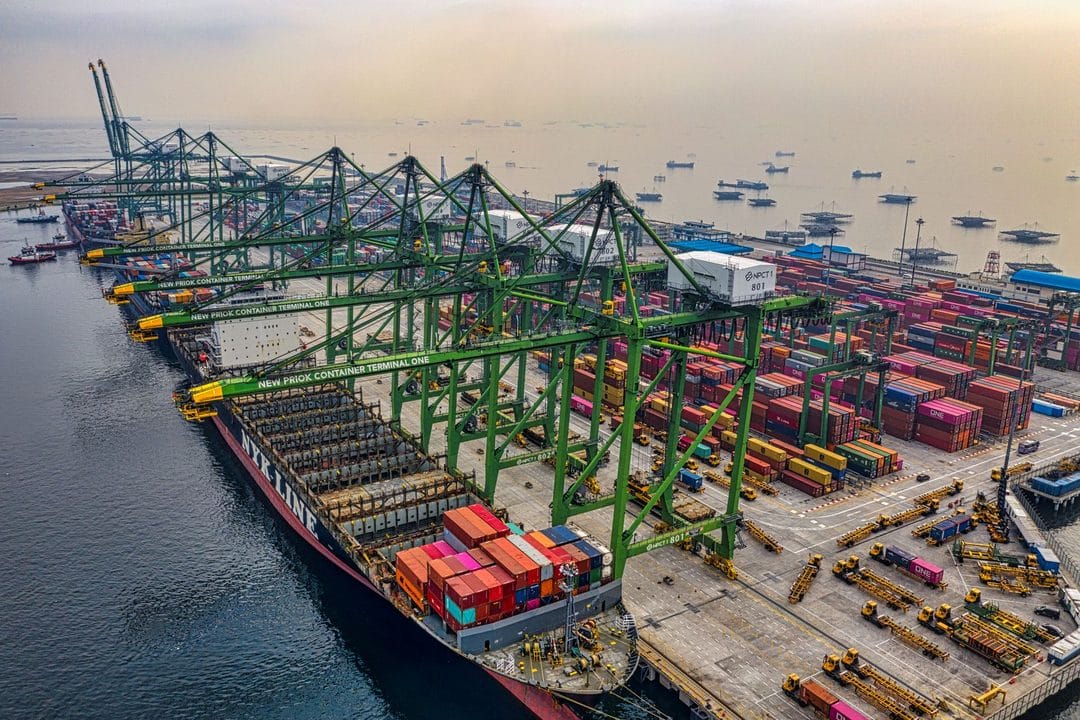
Vietnam's container ports handled a record 28.4 million twenty-foot equivalent units in the first seven months of 2026, according to figures released by the Vietnam Maritime Administration, as manufacturers continue shifting production capacity away from mainland China. Cai Mep-Thi Vai, the deep-water port cluster serving Ho Chi Minh City, accounted for roughly 40% of that volume, overtaking Singapore's transshipment growth rate for the first time since the port cluster opened direct services to the US West Coast in 2023.
The volume increase follows two years of accelerated factory relocation by electronics and apparel manufacturers, including several Taiwanese and South Korean suppliers that build components for firms headquartered outside the region. Samsung's Bac Ninh and Thai Nguyen complexes remain Vietnam's largest single source of export tonnage, but customs data show the fastest growth this year came from mid-sized furniture, textile and solar-component exporters relocating from Guangdong and Zhejiang provinces.
Port capacity under strain
Terminal operators at Cai Mep have reported vessel waiting times of up to 18 hours during peak weeks in June and July, according to shipping agents quoted by the Vietnam Ports Association, as throughput approaches the cluster's designed annual capacity of roughly 8 million TEU. The Ministry of Transport has approved an expansion plan for two additional deep-water berths at Cai Mep, with construction tendering expected to begin before the end of 2026 and completion targeted for 2029.
Haiphong, the main port serving northern Vietnam's electronics corridor, recorded a smaller but still notable 9% year-on-year increase in container volume. Analysts at Maybank's regional trade desk noted that northern Vietnam's growth has tracked closely with continued expansion by Foxconn, Luxshare and other electronics assemblers supplying US and European device makers, several of which added production lines in Bac Giang and Vinh Phuc provinces during the second quarter.
Regional comparison
Malaysia's Port Klang and Thailand's Laem Chabang have also posted volume gains this year, though at a slower pace than Vietnam's. Port Klang authorities reported a 6% increase in container throughput for the first half of 2026, driven largely by transshipment cargo rather than domestic manufacturing exports. Indonesia's Tanjung Priok, by contrast, recorded throughput roughly flat against 2025 levels, according to figures published by Indonesia's transport ministry.
Freight rates on the Vietnam-to-US West Coast route have risen 11% since January, according to the Freightos Baltic Index, a change shipping analysts attribute to a combination of higher demand and capacity constraints at Cai Mep rather than broader trans-Pacific rate movements, which have stayed comparatively flat over the same period. Separately, the Vietnamese government has continued negotiations on a bilateral customs-facilitation agreement with the United States, aimed at reducing inspection delays for electronics shipments, though no signing date has been confirmed.
The Ministry of Planning and Investment reported that foreign direct investment commitments into Vietnam's manufacturing and logistics sectors reached $14.2 billion in the first half of 2026, up from $11.6 billion over the same period last year. Port and logistics infrastructure accounted for roughly $1.8 billion of that total, spread across projects in Ba Ria-Vung Tau, Hai Phong and Dong Nai provinces.