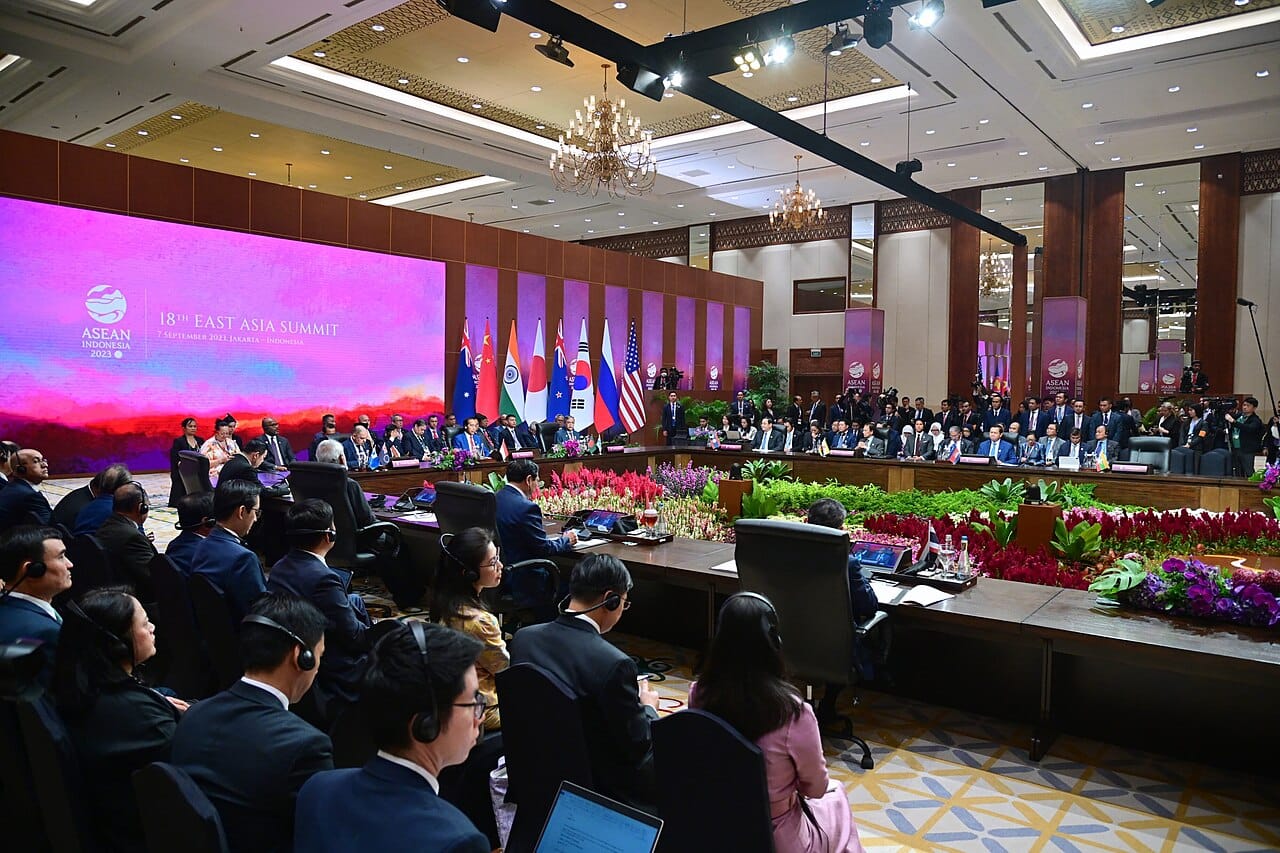
The 44th ASEAN Summit closed in Jakarta on 14 May 2026 with the kind of carefully worded communiqué that journalists outside the region typically skim and discard. What the document does not say plainly — but is being implemented in working-group memoranda already circulating in regional finance ministries — represents the most significant infrastructural shift in East Asian trade since the 2010 ASEAN Charter. Three specific decisions are worth tracking.
1. DCEP-RMB cross-border settlement gets ASEAN-wide pilot
China's digital currency (DCEP) had been confined to bilateral pilots with Vietnam, Cambodia and Laos through 2024-2025. The Jakarta summit endorsed an ASEAN-wide pilot mechanism allowing settlements in commodity trade — palm oil, rubber, rice, electronics components — to be routed through the DCEP rail using yuan as the unit of account. Six countries (Indonesia, Malaysia, Singapore, Vietnam, Cambodia, Laos) signed the operating MOU; Thailand and the Philippines reserved a 12-month consideration period. The mechanism does not displace USD invoicing in these trades, but it gives ASEAN exporters a parallel rail that bypasses the US correspondent banking system entirely. Indonesia's central bank Governor Perry Warjiyo described it in his closing remarks as "optionality, not substitution" — a phrase repeatedly emphasized to keep Washington's nervous reaction muted.
Why this matters beyond the rhetoric
About 35% of ASEAN's intra-regional trade is with China. Currently nearly all of it is USD-invoiced, generating roughly $4-6 billion per year in correspondent banking fees and FX spreads that flow to Wall Street and London. The DCEP rail compresses that to near-zero. By itself this is a fee saving, not a strategic shift. Combined with India's UPI cross-border expansion (active since 2024) and Indonesia's QRIS code-payments rollout, it represents the technical groundwork for a substantially less dollarised regional trade architecture by 2030.
2. BRICS-aligned strategic grain reserves
The summit endorsed a regional grain reserve framework with intentional alignment to the BRICS+ commodity coordination mechanism announced in Kazan in October 2024. Operationally this means Indonesia, Vietnam, Thailand and the Philippines will hold strategic rice and wheat reserves with disclosed inventory levels exchanged quarterly with India, China and Russia. The aim is to reduce the political volatility caused by India's periodic rice export bans (most recently 2023-24), which whipsawed Philippine domestic rice prices by over 40%.
The unspoken second purpose
The framework also gives ASEAN governments a mechanism to coordinate against speculative trading concentrated in Chicago, Singapore and Zhengzhou futures markets. Whether the framework is used for this purpose — or whether it remains a defensive food security mechanism — will become clear within 18 months when the inventory disclosure cycle starts.
3. The Indo-Pacific Maritime Air Corridor MOU
The least discussed but possibly most strategically significant decision: an MOU between ASEAN members and Japan/South Korea (as ASEAN+3 partners) establishing a coordinated air-traffic and maritime monitoring framework over the South China Sea, Taiwan Strait and East China Sea. Crucially, the MOU does not include China — and the framing was deliberate. Indonesian Foreign Minister Retno Marsudi described the framework as "complementary to existing arrangements," language that was carefully chosen to avoid characterising it as a parallel to China's preferred Code of Conduct framework.
What this means in practice
Real-time AIS and ADS-B data covering commercial vessel and aircraft movements across the region will be shared between ASEAN members and Japan/South Korea, with US Pacific Command receiving aggregated data through existing bilateral channels. Detection of military or grey-zone activity (Chinese coast guard incursions, militia fishing fleets, military aircraft entering Taiwan's ADIZ) will be flagged automatically. This is not a defence pact — but it is the infrastructure layer for one.
Three things to watch in the next 90 days
- China's response: Beijing's foreign ministry has been muted, suggesting the DCEP deal was bought at the price of acquiescence to the maritime air corridor. Watch whether this calculus shifts after the Chinese Communist Party's June leadership meetings.
- US reaction: the State Department issued a brief but carefully worded statement welcoming "ASEAN coordination" without endorsing the DCEP element. The real test will be whether USD-side US Treasury officials seek further bilateral pressure on ASEAN central banks, particularly Bank Indonesia and Bank of Thailand.
- Pilot transaction volumes: the DCEP-RMB pilot has a publicly announced ramp from $2 billion in 2026 to $40 billion by 2030. The actual H2 2026 volume figures, due in February 2027, will tell whether the rhetoric translates into trade flow.
Jakarta in May 2026 was not the kind of summit that generates dramatic headlines. It was the kind that the next decade of East Asian economic geography will be built around.