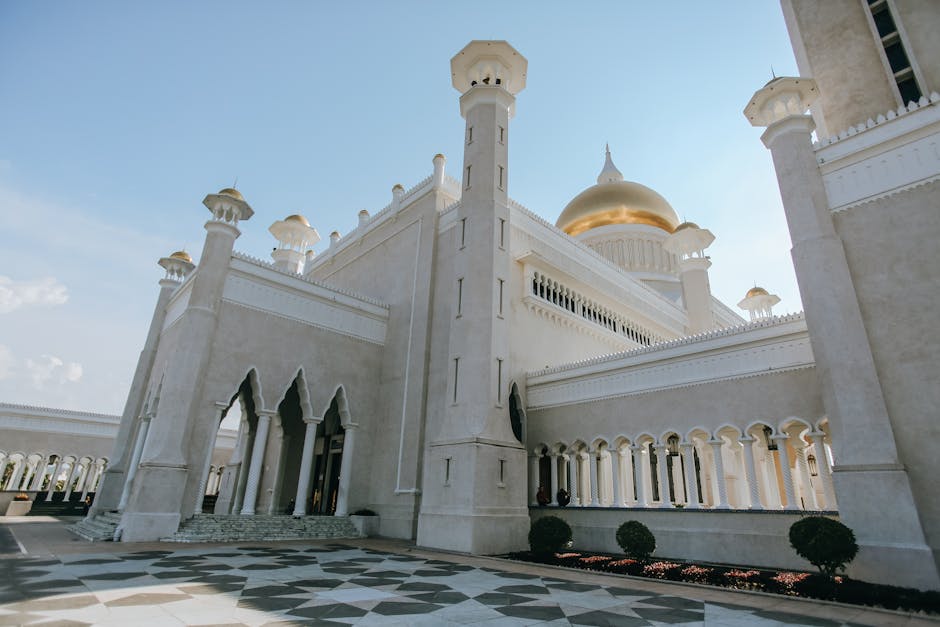
Sultan Announces $3 Billion Investment in Halal Industrial Park
Brunei's Sultan Hassanal Bolkiah announced a $3 billion halal economy development plan on February 8, 2026, as the small Southeast Asian nation accelerates diversification away from oil and gas, which still account for 60% of GDP. The centerpiece is a 500-hectare Brunei Halal Industrial Park in Temburong district, designed to produce halal-certified food, pharmaceuticals, and cosmetics for export to the $2.3 trillion global halal market.
The plan was unveiled at the Brunei Economic Summit attended by investors from Saudi Arabia, the UAE, Malaysia, and Turkey. "Brunei has the credibility, the strategic location, and the regulatory framework to become a global halal hub," said Minister of Finance and Economy Amin Liew Abdullah.
Oil Sector Reality
Brunei's proven oil reserves fell to 960 million barrels in 2025, enough for approximately 22 years of production at current rates. Natural gas reserves of 9.4 trillion cubic feet provide a longer runway but are also declining. The Brunei Shell Petroleum joint venture, which accounts for 90% of production, reported a 6% output decline in 2025 as mature fields entered natural depletion.
The IMF's latest Article IV consultation urged Brunei to "urgently diversify revenue sources" and noted that the fiscal breakeven oil price of $65 per barrel exceeded the $58 average in 2025, putting the budget under pressure for the first time in a decade.
Halal Hub Strategy
The industrial park will focus on five sectors: halal meat processing, with capacity to handle 500,000 head of cattle annually using Australian and Indian livestock; halal pharmaceuticals, targeting the underserved market for sharia-compliant medicines; halal cosmetics leveraging Brunei's tropical botanical resources; halal logistics and cold chain; and halal fintech and certification services.
Brunei's Halal Industry Innovation Centre, established in 2022, has already certified 340 products from 28 countries. The country's membership in ASEAN, the Organisation of Islamic Cooperation, and the Trans-Pacific Partnership provides market access to 3.5 billion consumers.
Challenges and Skepticism
Previous diversification efforts in Brunei have underperformed. The Bio-Innovation Corridor launched in 2012 failed to attract significant investment, and the ambitious Temburong Eco-Town project remains largely unbuilt. Labor force constraints — Brunei has a population of just 460,000 — and a public sector that employs 48% of the workforce present structural challenges.
A senior ASEAN diplomat, speaking on background, noted that "Brunei's halal ambitions face stiff competition from Malaysia, Indonesia, and Turkey, which have larger scale and deeper supply chains. Success depends on execution, which has not been Brunei's strength in diversification to date."