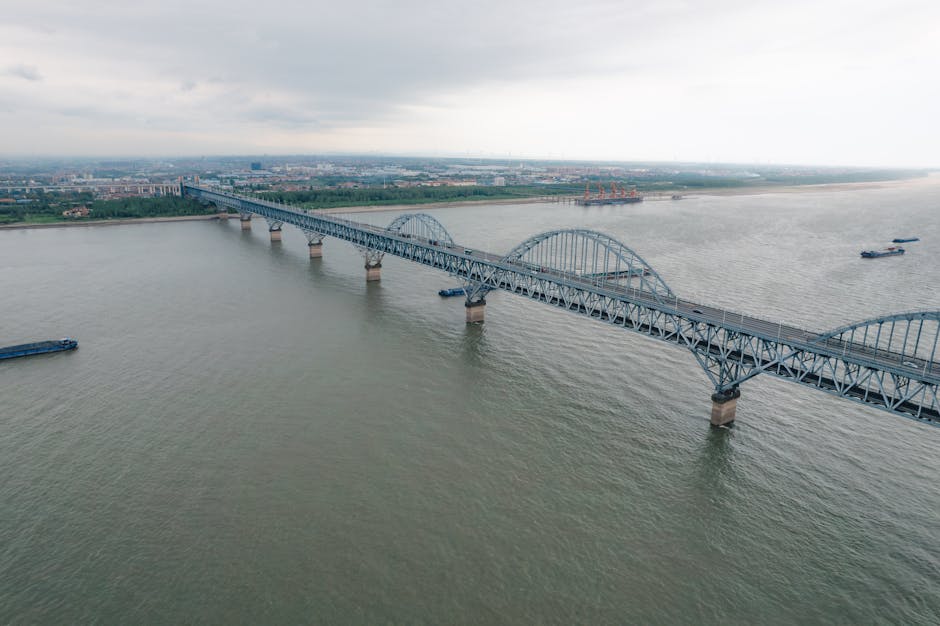
Qiongzhou Strait Bridge Spans 26 Kilometers Between Guangdong and Hainan
China opened the Qiongzhou Strait Bridge on March 29, 2026, a 26-kilometer sea crossing connecting Zhanjiang in Guangdong province to Haikou on Hainan Island. The $12.8 billion structure surpasses the Hong Kong-Zhuhai-Macao Bridge as the world's longest sea-crossing bridge and eliminates dependence on ferry services that have been the sole vehicle link to China's southernmost province.
President Xi Jinping attended the opening ceremony via video link from Beijing, calling the bridge "a symbol of China's engineering capability and our commitment to connecting all regions of the motherland."
Engineering Achievement
The bridge crosses the Qiongzhou Strait, one of the most challenging marine construction environments in Asia. The strait experiences typhoons, strong tidal currents of up to 3 meters per second, and seabed depths reaching 80 meters. The bridge includes a 6.8-kilometer immersed tube tunnel in the deepest section, the longest underwater road tunnel ever built.
Construction took seven years and employed 28,000 workers at peak activity. China Communications Construction Company, the primary contractor, developed new deep-water foundation technologies and typhoon-resistant cable-stay systems. The bridge carries six lanes of highway and is designed to withstand Category 5 typhoons and magnitude 8.0 earthquakes.
Economic Transformation
The bridge is expected to transform Hainan's economy by eliminating the logistics bottleneck that has constrained the island's development as a free trade port. Ferry crossings currently take 60-90 minutes and are frequently suspended during typhoon season; the bridge reduces crossing time to 20 minutes with year-round reliability.
The Hainan Free Trade Port Authority estimated the bridge would increase annual freight capacity between the mainland and Hainan from 40 million tons to 150 million tons, supporting the island's ambitions as a duty-free shopping hub, tropical agriculture center, and international tourism destination. Property developers reported a 45% surge in Haikou land prices following the bridge's construction announcement in 2019.
Strategic Dimensions
Military analysts noted the bridge's strategic significance, providing a reliable land corridor to China's largest naval base at Yulin on Hainan's southern coast, home to the PLA Navy's nuclear submarine fleet. Previously, military logistics to Hainan depended on vulnerable sea and air transport links.
The bridge includes a dedicated emergency lane and reinforced structural sections designed to accommodate military vehicle loads, though Chinese authorities characterize the project as purely civilian infrastructure. The bridge toll is set at 150 yuan ($21) per car, with commercial vehicles paying 450-1,200 yuan depending on size.