India's Air Quality Crisis: Delhi Records Worst AQI in Five Years
Delhi's air quality index hit 497, the worst in five years, as crop burning fires and a temperature inversion created dangerous pollution levels 30 times above WHO limits.
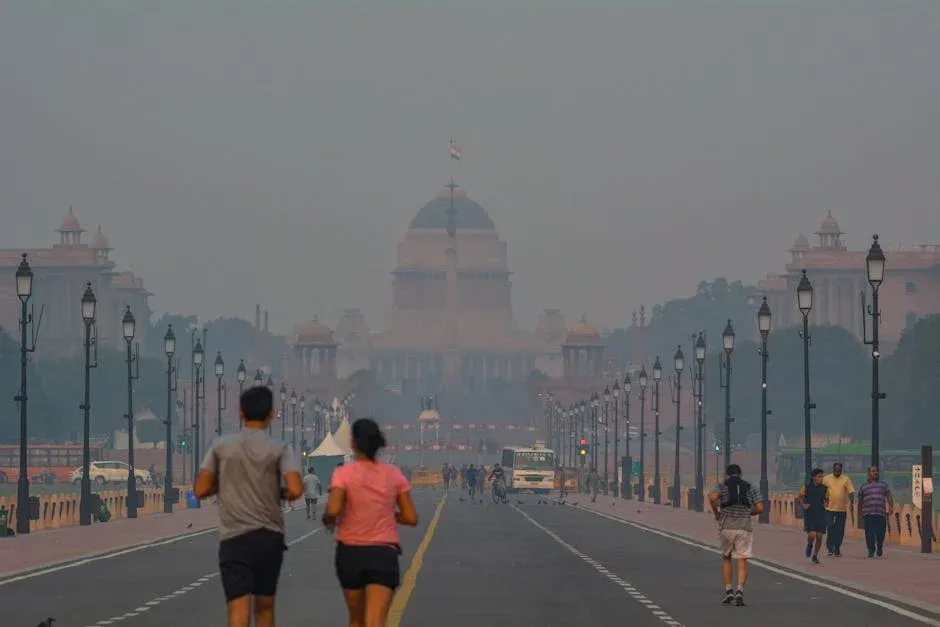
Schools Close as Particulate Levels Hit 30 Times WHO Safe Limit
Delhi's air quality index reached 497 on November 28, 2025, the highest reading in five years, according to the Central Pollution Control Board. PM2.5 concentrations exceeded 450 micrograms per cubic meter in parts of south Delhi — 30 times the World Health Organization's recommended safe level of 15 micrograms per cubic meter.
The Delhi government ordered all schools closed through December 5, banned construction activity, and restricted private vehicle use under its Graded Response Action Plan Stage IV emergency measures. Chief Minister Atishi Marlena declared the pollution a "public health emergency" and demanded federal intervention.
Sources and Causes
Satellite data from NASA's FIRMS system showed 48,000 active crop-burning fires across Punjab and Haryana between November 20 and 28, contributing an estimated 35% of Delhi's PM2.5 load. Despite a Supreme Court ban on stubble burning, enforcement remains weak, with only 2,300 penalties issued against farmers in Punjab during the 2025 season.
Vehicle emissions, industrial activity, and construction dust each contributed approximately 15-20% of the pollution load, according to the Indian Institute of Technology Delhi's source apportionment study. A temperature inversion layer trapped pollutants below 200 meters altitude, preventing natural dispersion.
Health Impact
The All India Institute of Medical Sciences reported a 340% increase in emergency room visits for respiratory complaints between November 25 and 28. Dr. Randeep Guleria, former AIIMS director and now an adviser to the Health Ministry, said prolonged exposure at these levels was "equivalent to smoking 25 cigarettes per day."
A study published in The Lancet Planetary Health in October 2025 estimated that air pollution causes 1.67 million premature deaths annually in India, with Delhi and the Indo-Gangetic Plain bearing a disproportionate burden. Life expectancy in Delhi was reduced by an average of 11.9 years due to air pollution, according to the University of Chicago's Air Quality Life Index.
Policy Responses
The Commission for Air Quality Management ordered a 50% reduction in truck traffic entering Delhi and activated anti-smog guns at 85 construction sites. The Delhi Metro extended operating hours to encourage public transit use, and the government offered free bus rides during the emergency period.
Environmental attorney MC Mehta, who has argued air pollution cases before the Supreme Court for three decades, called the annual crisis "a governance failure of monumental proportions." The Supreme Court has scheduled a hearing on enforcement of anti-pollution measures for December 10.