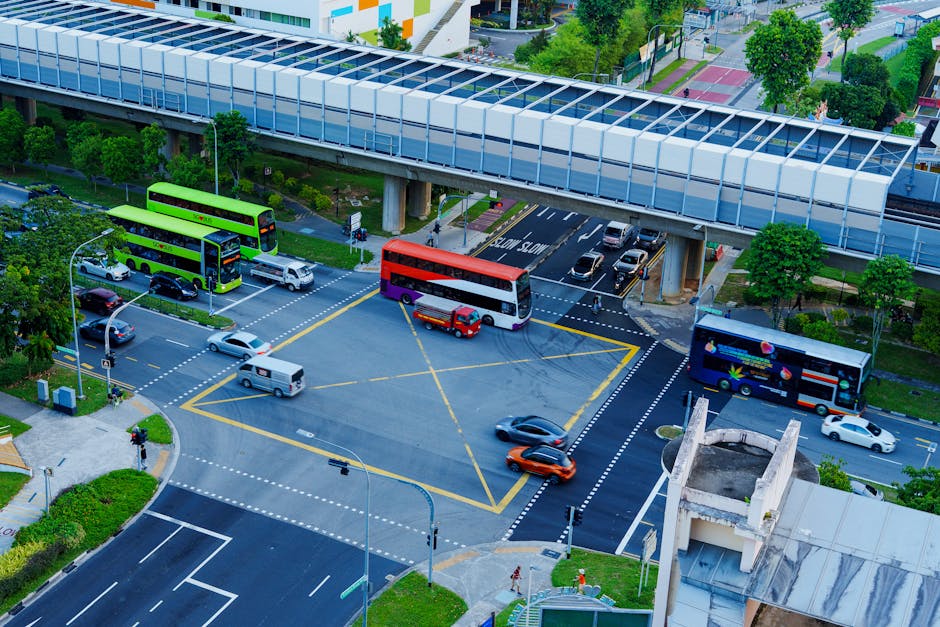
Land Transport Authority Approves Driverless Buses on All Major Routes
Singapore's Land Transport Authority announced on March 1, 2026, the deployment of autonomous buses across all 12 major trunk routes by 2028, making the city-state the first nation to operate a nationwide autonomous public transit network. The $4.2 billion program, developed in partnership with Volvo Autonomous Solutions and local technology firm ST Engineering, will introduce 900 driverless buses over three years.
Transport Minister S. Iswaran said the decision followed three years of successful pilot operations in Punggol and Tengah new towns, during which autonomous buses completed 2.8 million kilometers with zero at-fault incidents. "Singapore has the infrastructure, the regulatory framework, and the public trust to take this step," Iswaran said.
Technical Infrastructure
The autonomous buses use a combination of LiDAR, camera arrays, and V2X (vehicle-to-everything) communication with smart traffic infrastructure. Singapore has installed 45,000 connected traffic signal units and 8,000 roadside sensors across the island, creating a digital twin of the entire road network updated in real-time.
Each bus carries Level 4 autonomous driving capability — fully driverless under defined conditions — with remote monitoring from a centralized operations center staffed by 200 operators who can intervene in edge cases. The system handles Singapore's challenging driving environment of dense traffic, frequent rain, and complex intersections.
Workforce Transition
The National Transport Workers' Union negotiated a transition package for the 6,500 bus drivers affected by the phased rollout. The package includes guaranteed employment through 2030, retraining subsidies of up to SGD 50,000 ($37,500) per worker, and priority placement in autonomous vehicle monitoring, maintenance, and emergency response roles.
NTUC Secretary-General Ng Chee Meng said the agreement was "a model for managing technological disruption without leaving workers behind." Approximately 2,000 drivers are expected to transition to autonomous vehicle operations roles, while others will move to adjacent sectors including logistics and ride-hailing services.
Global Implications
Singapore's decision is being closely watched by transit authorities worldwide. Dubai's Roads and Transport Authority, Tokyo's Bureau of Transportation, and Transport for London have sent delegations to study the implementation model. The International Transport Forum at the OECD cited Singapore's approach as "the most comprehensive regulatory framework for autonomous public transit globally."
The Economic Development Board estimated the autonomous vehicle ecosystem would generate SGD 3 billion ($2.2 billion) in annual economic value by 2030, including technology exports, R&D investment, and operational savings. Singapore-developed autonomous driving software is already licensed by transit operators in Helsinki and Taipei.